Log InCartCall Now: (616) 667-7297

How to Use Anatomy to Groom the English Setter

Anatomy is the Foundation of All Grooming 

You’ve heard me say this before:

All dogs – whether a Yorkshire Terrier, a Great Dane, a Bulldog, or a Dachshund – possess identical bone and muscle structure. Fundamentally, they all are the same.

Excellent grooming starts always starts with a firm understating of canine anatomy. It is the FOUNDATION of all grooming.

Basic pattern lines are set based on the muscle and bone structure.

Depending on how physically active a dog is, the muscle structure may be very prominent. It could be lurking under a layer of fat. It may also be poorly developed due to age or lack of physical activity.

Nonetheless, those muscles are there. They will help you set symmetrical and correct pattern lines.

The bones are there, too. Whether the dog is anatomically correct when compared to the breed standard is something else altogether when we are dealing with pet dogs. Understanding what a physically sound dog is will help you immensely. When you know the difference between good and bad structure, you’ll be able to hide many faults.

When we combine all the layers of the dog – the bones, muscles, the skin and the fur – we will be able to mold and shape the coat to highlight the dog’s best features and downplay the others. If the bone structure is a little less than perfect, you can use the hair to camouflage those defects.

Before you begin grooming any dog, get your hands on them! Close your eyes. Feel the structure under the coat. Sink your fingers deep in the fur. Pay close attention to the muscle groups highlighted in color in these diagrams.
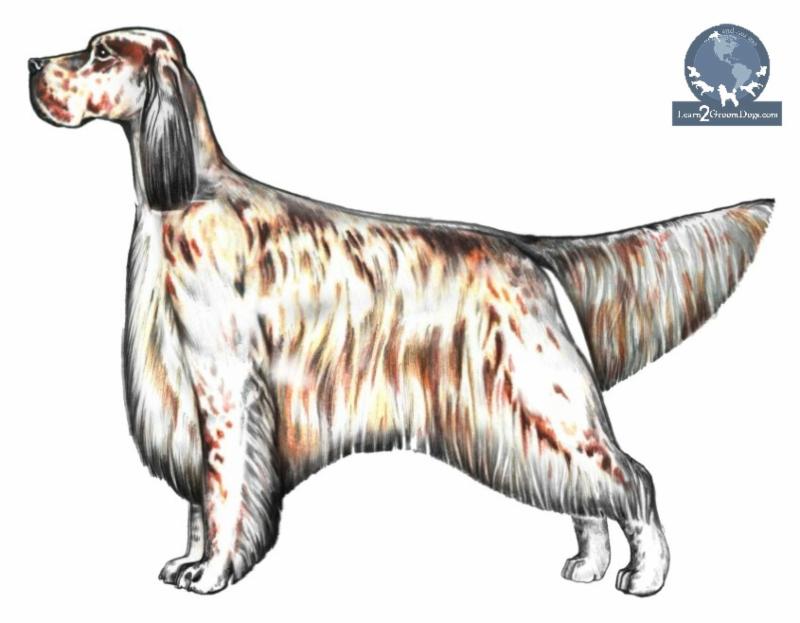
The Essence of the Breed

Before you start grooming any dog, you need to familiarize yourself with the breed and understand its essence.

The English Setter is a Sporting dog of great style. It should be physically fit and structurally sound to work long hours in the field flushing game. The general outline of the English Setter will be rectangular. The shoulder lay back and the angles of both the front and rear assemblies should allow for adequate reach and drive.

The coat is silky, flat, and should lay close to the body. English Setters have longer feathering on the ears, chest, abdomen, underside of thighs, back of all legs, and on the tail. The longer coat should not be so long as to hide the true lines of the dogs, movement, or the function of field hunting.
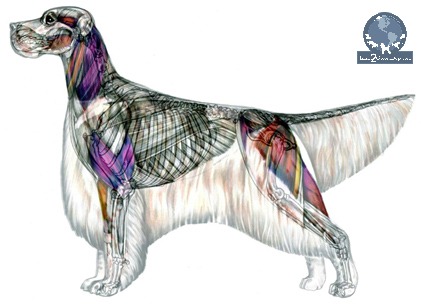
Landmarks for Grooming & Styling

When it comes to grooming, let’s work around the dog using its anatomy as a reference.

When done “correctly,” Setters are hand stripped for a very natural look. However, in pet grooming circles, it is common to see the pattern clipper-cut or styled using a combination of clipping and stripping to save time. Regardless of the method you chose, the anatomy reference points – or landmarks – will remain the same.

Setting the Throat: Feel for the muscles at the sides of the neck to set the throat pattern line. A visual clue to this area is at the “frill” or cowlick line running down the sides of the neck. The throat area is directly below the jaw, inside the muscles running down the outside of the neck. The shape is generally a soft “U” shape. The lowest part of the “U” stops a few fingers above the prosternum bone.

Body: The jacket coat on the bulk of the body is shorter and lays flat on dog. Follow the natural lay of the coat when working this area.
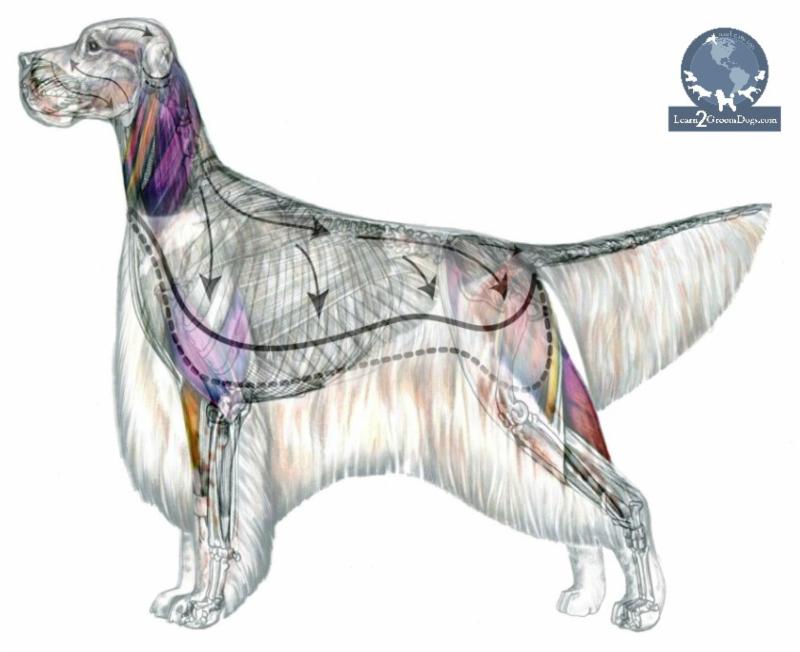
Shoulder: Use the turn of the muscle at the shoulder to set the jacket pattern on the body.

Elbow: The turn of the shoulder will also tell you the location of the elbow. This is the general location of where to start the pattern on the body, sweeping back and upwards towards the flank of the dog.

Spring of Rib: The turn of the ribs will help set the pattern line separating the dog’s body jacket which consists of much shorter coat, blending invisibly into the longer feathering found on the lower portion of the dog’s body.

Undercarriage: The undercarriage line creates a focal point for balance of the overall dog. The highest point of the graceful sweep will be directly under the last few ribs.

Flank: Moving into the flank area, the thigh muscle should be exposed to help accentuate a physically fit and muscular dog.

Tail: For balance, the tail should reach to the hock and be a triangular flag. There is a slight gap of fur on the underside of the tail at the base. This slight space separates the longer rear furnishings with the feathering on the tail.

Topline: The top line maybe level or slightly sloping from the withers to the tail.

Neck: The long graceful neck is well muscled and slightly arched.

Head: The lines of the skull are parallel with a well definite stop.

Ears: Set well back and low, even with or below the level of the eye.

All these areas are natural landmarks used as reference points on any breed. When you combine anatomy with the official breed standard for any purebred dog, you have knowledge. You can use this understanding to accentuate the proper structure of the English Setter.

Always remember, all transition lines should be invisible. Ideally, the English Setter should look totally natural when finished – as if the coat simply grew that way.

Combining the use of these anatomical landmarks and skillful technical skills, a talented pet stylist can easily create a symmetrical, stylish, and well-balanced trim on any dog – purebred or mixed breed.

Happy trimming!

~Melissa

MVpaw_no_Inner_whiteP.S. Has this helped? Let us know if there are other topics you’d like us to explore.  Jump on the Learn2GroomDogs.com Facebook page and tell us what would help you.


The 2017 Westminster Kennel Club Dog Show is Almost Here!

Westminster2017-1This time of year I always get excited. The 141st Annual Westminster Kennel Club Dog Show is just around the corner! For almost as long as I can remember, I have firmly planted myself in front of the TV for two nights. I would watch the show in its entirety. Why?

Because, the Westminster Kennel Club Dog Show is the “Superbowl” of the dog world. It is the best way to stay up to date with the latest trends and styles. I would throw a Westminster party. I loved inviting my entire grooming team over to be glued to the TV for two nights as the show aired. For days after the show, we would talk about the newest breeds that had been accepted by the AKC. The unique haircuts we saw. The latest style trends on established breeds.

The show was important for me. I was actively competing in the pet grooming contest arena. In the old days, we would record the show on VCR tapes. I can’t tell you how many times I would review those tapes before I stepped into the contest arena. Today, you can stream videos to any device or save it on DVR systems. By watching some the most spectacular dogs in the country compete at this level, I was able to get a clear image etched in my mind before I stepped into the ring at a grooming competition. Visualization is a key to success.

Secondly, I used the Westminster Dog Show as a way to help keep my grooming staff up-to-date with the latest styling trends.  Once I opened The Paragon School of Pet Grooming, we continued to use the show as a key learning tool for students. The annual dog show was instrumental for students learning breed identification and trim styles.

Tune in this year and enjoy the 2017 show. The Westminster Dog Show airs Monday, February 13 LIVE ON Nat Geo WILD from 8-11 p.m. and Tuesday, February 14 is LIVE ON Nat Geo WILD from 8-11 p.m. For streaming videos of each individual breed class, click here.

Happy Trimming!

~Melissa

MVpaw_no_Inner_white

P.S.  Do you watch? Jump on the Learn2GroomDogs.com Facebook page and tell me your thoughts about how to use this show or other resources to inspire yourself and your team.


Top Five Reasons I Don’t Allow Blue Jeans at Work

jeansI know I’m going to ruffle a few feathers with this blog. But… my blog – my opinions. It’s ok if you don’t agree with me, but this is how I feel.

Call me old-fashioned. Call me a stick in the mud. Call me conservative. All of them are true.

When it comes to presenting a professional image appealing to our service-based clientele, I want simplicity. I want neat. I want clean.

Why?

Professional pet groomers have an image problem. As a whole, we are not seen as “true” professionals. We are not respected. Professional pet grooming is not commonly viewed as a credible profession. My father wasn’t thrilled about my early career move back when I was twenty. (He’s OK with it now!) What about your dad?

Unfortunately, this image problem is often well deserved. We are our own worst enemies. If we want to be true professionals, we need to look and act the part. Not just in how we present ourselves, but how we present our businesses, as well. Are we personally presenting a neat, tidy, and clean appearance? What about our salons and mobile vans?

If we can’t groom ourselves, how do we ever expect our clientele to view us as educated professionals? How do we instantly gain their trust? How do we build a long-term relationship based on respect?

None of this will happen if we don’t take pride in ourselves and our workplace.

Not allowing my team to wear blue jeans at work is my first line of defense.

We have less than 30 seconds to make a first impression. When a new client walks in the door, the impact is almost instant. What do they see? What do they smell? And what do they hear?

I’m not here to argue some people can rock it in a pair of well-fitted blue jeans. The problem is – most of us can’t. When I’m working with a large team of people, it’s much easier to require a basic dress code.

Dress codes don’t have to be complicated. They go a long way to set the first stages of creating a positive first impression.

006b14ed7c8bcb88d198fb55ef140b6c_-dress-for-success-and-dress-for-success-clipart_1602-16035 Reasons Why A Dress Code is Good For Business

  1. A dress code creates uniformity. Keep it simple. Matching attire goes a long way to create a positive impact on clientele. Black, khaki, or even white slacks, capris or longer shorts look professional, especially when teamed up with coordinating business shirts or jackets. Some pet service businesses find matching medical scrubs a simple way to unify their team. If you’re dealing with dog hair all day, matching hair-repelling garments make it simple to look stylish. Clients instantly know who is a staff member.
  2. It’s controllable. With a well-written dress code, it’s easy to get a consistent look within your entire team. Plus, it’s easy to enforce it.
  3. It minimizes risk. Dealing with dogs all day presents risks. You need to be stable on your feet and be able to stand for hours. Sturdy footwear is a must. Hooped jewelry poses a health threat to the wearer when handling dogs.
  4. It builds trust. Having a clean, crisp, and simple – but polished – dress code in place instantly builds credibility with clients. Trust is at the heart of all successful service based business, bringing clients back on a regular basis.
  5. It simplifies life in general. Today, we all have hundreds of decisions to make. By establishing clear boundaries with a dress code, you simplify your team’s daily decision-making process. By giving them direction on what to wear to work, they clearly understand what type of impression the company puts out to its clients and potential customers.

Some employers struggle with employees who believe they have the right to dress and groom in a way that represents their personality. This is true – outside of the employer’s business. However, businesses have rights to establish a dress code that aligns with their company and their target market. While individuals have a right to express themselves, so too do businesses. The way your employees dress sends intended or unintended messages to your clientele.

Suitable attire, along with basic politeness, cleanliness, and knowledge are a few of the most common threads within professionalism. Torn, sloppy, or ill-fitting blue jeans, in my opinion, do not convey the type of professional image I want to present to the community.

It’s human nature to form instant options of others. Personal presentation affects the perception clients have of you, your business, and your team. It is important to maintain a dress code which creates a positive first impression.

Never forget, the point of a dress code and professional conduct, at all levels, is to make others comfortable, including your clients. Its implementation ensures the instant impression a business is credible, trustworthy, and reliable.

Happy trimming,

~Melissa

MVpaw_no_Inner_white


P.S.  I know this is a controversial topic.  Let’s talk about it.  I want to hear what you think.  Jump on the Learn2GroomDogs.com Facebook page and tell me your thoughts.


Thinning Shears are the Pet Stylist’s Eraser

Are you thinking about upgrading any of your pet grooming tools? For many dog groomers, The Groom Expo in Hershey, PA that is coming up later this month is a perfect time to see and test new items for your tool kit. If you are saving your tip money to buy new thinning shears, this blog is for you!

pencilThinning shears (or blending shears) are the best-kept secrets in the grooming world. Used properly, they can make mistakes much less noticeable. For a new stylist, this is one of the first shears I always recommend upgrading in your toolbox.

It doesn’t matter how long you’ve been grooming or how talented you are as a pet stylist – sometimes you just need a little help. An “oops” can occur at any time. Mistakes happen.

Maybe there is a spot on the coat that you just can’t get smooth. Maybe there is tracking in the coat from the clippers or guard comb. You may have left scissor marks in the coat – or a hole in the coat you accidentally made with clippers or scissors. You might even be working with a dog that will not hold still long enough to work safely with clippers or scissors – leaving the coat rough and jagged.

Thinning shears can be your savior. They erase rough spots. They blend out jagged edges. They smooth out transition areas. They fix mistakes.

The difference between a good stylist and a great stylist can be determined by how much value they place on their blending shears.

ToolboxStylists that understand the value of this type of shear will invest in multiple pairs. Just like straight edge shears, there are wide varieties from which to choose. Some are for more general use while others have more specific usage. The key is to know how you want to use the shear. Do you need it for light wispy coats? Drop coats? Terrier styling? Working around the head or eye area or dealing with large surface areas? There is a blender to fit every single one of these needs.

I always suggest you personally try out thinning shears before you purchase them. Just like Colin Taylor says, shears are like shoes. You need to find the ones that fit you! They have to fit properly as well as cut smoothly and run effortlessly in your hands.

So how do you narrow down your choices? Ask. Find out what other groomers and stylists are using. Determine which thinning shears they rely on every day in their salons. Believe me, they have opinions! There are lots of fabulous thinning shears out there – but there’s also a lot of junk.

Most high quality blending shears will have an average cost of $150 – $350. Of course, you can spend more if you like. Your equipment is an investment in your career. You may not need the Rolls-Royce when you first start out – but you do need something that is reliable and dependable. Luckily, there are many styles and varieties from which to choose.

royale-double-teeth-thinning-shear-bladesThe difference between a good stylist and a great stylist is that they know how to fix mistakes. Every one of us makes them. Having a nice collection of thinning and blending shears will be the erasers you need when that “oops!” happens.

What are your favorite shears? What do you look forward to shopping for when you go to Hershey? Jump over to the Learn2GroomDogs Facebook page and tell us about it!

Happy trimming!

~ Melissa


Do I Really Need to Learn Anything Else?

(Welcome to my blog!  This week, my marketing expert, Joelle Asmondy, will be filling in for me.  Joelle is a whiz with marketing and is a firm believer in education.  Enjoy!)

handI was at one of our industry’s amazing trade shows recently and had a brief but memorable exchange with a lady that walked past our booth. I wished her a good morning and without turning her head, she glanced at the table in front of me and the many books we had on display. Never breaking stride, she dismissed me with a quick,
“I’ve been in this business for 28 years – I’m good.”

“What a blessing that she has been in business that long!” I thought. “AND that she still comes to trade shows! She must really love the work she does!” I was so impressed that for a second I didn’t realize the subtext of our “conversation.”

“I don’t need to learn anything else.”

Wait – what?!

It was such a quick encounter, but I can’t stop thinking about it. I’ve replayed it over and over in my head. This morning I finally realized why this struck such a chord with me.

ramirez-bored-yawnWhen I was working my way through college, I worked for several months in a plastics assembly plant. The work wasn’t hard and I actually enjoyed working with my hands, but I could see the lifeless glaze in the eyes of my co-workers who had been at the job for years – and would probably never leave. They had done the same tasks at the same stations for years. There was no challenge in it for them anymore. They would fall into trance-like states while working. This was not the same look I got when I lost myself in a painting I was working on, when time fell away and I lost track of my surroundings until I came up for air. This was different. For them, everything was the same, with nothing to stimulate or relieve the mindless repetition until lunch time. There was no joy and no pride in what they were doing. It was just a job – something to be done for a paycheck.

Dog grooming, like anything else, has routines. It’s how we maintain consistency, quality, and safety. However, I just can’t imagine being satisfied with doing things the same way, every day, for the rest of my life. After all, technology changes. Breed standards evolve. Styles change. People certainly change. How can anyone in an industry as rich and diverse as ours possibly think that there is nothing more to learn, nothing to be gained by looking at something anew?

“I’m good.”learning-priorities-Development

Anyone in sales or who works a trade show will tell you that you have to accept hearing, “no” more than you hear, “yes.” Was this person just telling me that she didn’t want to spend her money with us? Possibly. Maybe she had other priorities – shampoo, sharpening, new shears – that needed the cash in her wallet. I respect that. The difference is the deferral she gave. It wasn’t, “I already have that,” or “No thanks,” or even, “Leave me alone.” I have a very strong feeling that, had I offered the books for free, I would still have been met with, “I’m good.”

“I’ve been in this business for 28 years….”

I love it when people stop by to tell us how long they’ve been grooming – and that they still love learning new things. I love it because I know they’re happier in their lives. There’s something about trying new things and embracing change that stimulates us and makes us thrive, not just live. Think about the last time you experimented with a new technique. Maybe you tried Asian Fusion for the first time and your customer LOVED it? Maybe you learned a different scissoring method that saved time and effort which enabled you to groom another dog each day – or to go home a little earlier? Maybe you tried a new shampoo that reduced the amount of time you had to spend brushing a tangled pet and your arms weren’t so tired every night?

13178553_10154208688333593_7385084264050383064_nWhatever it was, it happened because you were open to learning something new. Does that mean you HAVE to go out and buy our books? Of course not (although we wouldn’t mind!). Don’t automatically short-change yourself because you’ve been at it for years. There is always something new to be learned and so much more to life than just slogging through the days.

Successful people know that learning is the key to their success. If you settle back and decide that you’ve learnt everything you need to know about running a business, about succeeding in your career or about managing and motivating your team … you’ll lose out to competitors who have a passion for learning.”

So true.

It may not be easy or convenient to learn new things. It takes time to adapt to new things until the change feels natural – but isn’t it worth it? Best friends were strangers at first. Think of all the movies you might have missed, the books you’d never read, and the amazing food you’d never have experienced if you’d never tried anything new. I try new things every day and I can honestly say that because of it…

“I’m good.”


Make it a great week!

~ Joelle Asmondy

Are YOU still learning?  What inspires you to keep educating yourself?  Jump over to the Learn2GroomDogs Facebook page and tell us about it!

How to be an Indispensable Groomer’s Assistant

Wallpapersxl Dog The Wet Hq For 695583 1366x768It always shocks me when a competitor or a workshop participant presents me with a DIRTY DOG for evaluation. A dirty dog?! No joke – it happens all the time.

Nails are not trimmed correctly.Coats are not dried properly or completely.

…or worse yet, there are still mats and tangles left in the coat.

It’s not good grooming but I see all the time. Not only in the ring or at hands-on events, but in salons, too.

To me, bathing and drying are the most critical parts of any groom. One bather can make or break your entire grooming department.

Here are 7 skills I look for in an indispensable groomers’ assistant (AKA the bather!) All 7 of these skills must be MASTERED if you want to be highly valued in your grooming salon, if you want to move ahead in your career, or before you can gather loads of glowing clients.

1Be able to identify popular breeds

Anybody working professionally with pets needs to be able to identify the top 15 or 20 breeds that regularly come into your salon. It’s the fastest way for groomers to be able to communicate to one another.

2Be able to handle pets safely and compassionately

How many times have you heard others (or maybe even yourself) say, “This dog is driving me nuts!” Impatient treatment of a pet is never acceptable. If you lose control, you can bet that you won’t have clients for long. Being able to understand canine body language is job requirement #1. If you are going to win the pet’s trust and cooperation, you must be able to speak its language. It will keep you and the pet safe. It will also make the entire experience much more enjoyable for all parties.

3Understand the many different coat types found on individual pets

Each coat type has special needs that need to be addressed in the bathing and drying process to get the best results. A Beagle has different bathing and drying needs than a Standard Poodle. The same holds true with a coat on a Golden Retriever or an Airedale Terrier. A talented bather will instantly be able to identify dogs that possess simple coats or dogs that are going to be time-consuming and a challenge.

4Bathe the dogs until their coats squeak

If they don’t squeak, they are not clean.

Period.

This is the foundation of every fabulous grooming job. I cannot stress its importance enough. There are many products on the market to help achieve superior results in only one or two baths. Even if you use the best shampoos on the market, the dog will not get squeaky clean unless they are rinsed thoroughly. Rinse until the water runs clear and you hear the “squeak” when you push the water through the coat. And not just the easy to see or reach parts. Get soap and water to the undercarriage, under the ears, and the special parts. If the whole dog isn’t clean – it’s still dirty. Nothing wastes time or money more than having to re-bathe a dog because you didn’t do the job right the first time. There’s an old saying: if you don’t have time to do it right, when will you have time to do it over? Get it right the first time.

5Dry the coat to perfection

Most of the time, this will mean utilizing a form of active drying. There are several drying methods and combinations to choose from, based on the coat type, trim, and the pets’ tolerance. Incorrect techniques or careless attention to drying will waste more time than almost anything else in the grooming process. In most cases, high velocity and stretch (or fluff) drying techniques will need to be used to get superior results. Oh, and the pet needs to be bone dry too!

6Learn efficient and SAFE brushing techniques

Systematic brushing is the only way to effectively work through a coat and get right down to the skin. Selecting the correct tool for the coat type will be important. Knowing how to hold the tool along and how much pressure to exert is also important. Not enough pressure and you will not be efficient. Too much pressure and you’re going to make the pet uncomfortable and could cause injury. The key is to work methodically and gently over the entire dog – right down to the skin until a wide tooth comb can easily be pulled through the fur.

7Nails, ears, and glands

Trimming nails and cleaning ears is just an automatic process when it comes to grooming pets. If it is not done – or not done well – it’s considered sloppy. Clients don’t want to spend their hard-earned money on sloppy work. Stylists executing haircuts should not have to go back and double-check this type of preliminary pre-work. Some salons routinely check and/or express anal glands. Whatever your salon option is, you should follow their guidelines.

Being a bather – or being a groomers’ assistant – can be extremely rewarding. However, it does carry a lot of responsibility. Many of these skills are considered the foundation of all grooming.

Remember: every owner faces a choice when it comes to grooming. They can come to you, do the job themselves, not have the pet groomed all… or go down the road to someone else. Make sure they make the right choice by sticking with you.

What do you look for in a great groomer assistant? Jump over to the Learn2GroomDogs Facebook page and tell us about it!

Happy Trimming!

~ Melissa


Salvage Work

Many of us are seeing a lot of pets that are ready for a great makeover.  With that in mind, I thought it was the perfect time to revisit my blog on salvage work.

As many of you know, I’m a big dog person.  Working on these large furry dogs that have a huge shedding problem is one of my favorite things to do in a grooming salon.  I know, I know, call me crazy – but I just love seeing the transformation in this type of job.  Over the years I’ve gotten really quick with the process and rarely cringe, no matter what the size of the dog, nor the condition – I see it as a fun challenge!

My #1 rule is: Never work on a dirty dog. If water can penetrate the coat, let your products do the job.

Working on a dirty dog is not only unpleasant, but it also takes longer to do.  Plus, there will be a lot of coat damage and breakage.  A dirty coat is dry and brittle. The dirt and dander trapped within the fur makes it more difficult to brush out. Working on a clean coat will be easier for both you and the pet – and much more pleasant.

If there are large chunks that water cannot penetrate, go ahead and break up the tangle using the tool that is safe for the pet.  Don’t worry about removing it completely, just break it apart so the water and shampoo can do its job.

Prepare your bathing area.  If the dog is exceptionally dirty, use a shampoo especially designed for dirty dogs.  Using a follow-up treatment of a skin and coat conditioner after bathing twice (or maybe three times in some areas) will assist with the brush out and dead coat removal during the drying process.  Make sure you have all the tools you’ll need to aid in getting the dog clean like rubber curries or scrub brushes.  And make sure you have plenty of towels handy.  To see my video lesson on salvage work at Learn2GroomDogs.com, click here.

K9IIIVS-LGMy favorite trick when working with this type of job is to bring my high velocity dryer right into the bathing area (bring your eye and ear protection, too!).  With the dog fully lathered, blow the shampoo right off the pets while they are tethered in the tub.  The slippery soap will allow the dirt, loose coat, and tangles slide out, being trapped in the shampoo and sticking to the back wall of the tub, minimizing the mess.  Not all the shedding coat or mats will be removed but a lot will, making your job easier once you transfer to the drying table.  Once you have blown out the pet,follow up with the rinsing process.  Repeat this process as many times as necessary to get the dog “squeaky clean.”Once the pet is clean and thoroughly rinsed, apply a skin and coat conditioning treatment before heading to the drying table.  Read your directions: some conditioning treatments need to be rinsed out while others do not.  Your high velocity dryer and a heavy slicker brush will be your best friends during the drying process.

Rule # 2: Be Methodical and Thorough

First, blow out as much moisture and loose coat at possible with the air flow.  Use the highest power setting the pet is comfortable with, and a condenser cone.  Once you have pushed as much water and loose fur from the pet, remove the condenser cone, and bring the air flow close to the pet’s skin.  “Boost” any loose coat out of the dog by lightly patting the area where the air is striking the skin with a slicker brush.

Continue to work over the dog in a methodical manner until your brush glides through the coat easily and no more loose coat is trapped in the brush.

Rule #3 – ENJOY!

When the dog is complete, it should smell clean and fresh.  The coat should be glossy and float freely as the dog moves.  There should be an irresistible desire to reach down and bury your hands in a freshly groomed pet.

What are your best methods? Jump over to the Learn2GroomDogs Facebook page and tell us about it!

Happy Trimming!

~ Melissa


Production Bathing & Drying

production-blogPet bathing and drying seems to be a huge time challenge for many professionals. Many of you are all overflowing with pets to bathe during the summer season. I thought this would be a great time to review my time-tested “game.” I loved to play this game whether it was with 8 or 80 dogs a day! I’ve done it both ways and every number in-between over the years.

If you are one of those high volume shops doing 40 – 70 or more pets per day…  that’s a lot of toenail trimming no matter how you look at it!! How can you get more done in less time while not letting the quality of the work suffer? Here’s my method –  it’s a fast paced game with lots of variables to mix it up every day. After all, whoever thought pet grooming was going to be a boring job?

It’s not a mystery but it is like cooking a meal. The larger and more extravagant the meal (with multiple dishes being served), the more complicated the timing and the choices get to be. With a few dogs, it’s pretty simple – the choices are limited. Add more dogs and the variables increase.  Move to a full-blown shop pushing through 50+ dogs and you have something like a full force, successful restaurant that is managed by an experienced head chef.  OK, so how do you manage your bathing and drying roster so all the pets are done to the highest degree of quality and proficiency, just like getting multiple dishes to the table all done to perfection and hot?

The Three Basic Rules & Guidelines to Follow

1Review all the dogs on your roster for that day or session. This game works best when you have multiple pets arriving at one time so you can stagger them according to coat type, size, and degree of difficulty.

2Do your largest and furriest dog first. Something that can be bathed and then lightly high velocity dried to lift and separate the fur. By spending a few minutes with the high velocity dryer on each pet, it allows a clear view of any special needs of that animal while enhancing airflow to the coat once it is placed in an inactive drying situation. Bathe and set up the coat on all the bath and brush pets first, starting with the largest and most time-consuming dogs, working down the line of difficulty to the least difficult of the bath and brush pets. Once all the bath and brush pets are bathed, then proceed with dogs that need active drying to yield the best results

3Your goal on all trim dogs is not only to get the pet clean, but the coat needs to be tangle free and as straight as possible for the finished trim. After all the B&B pets are bathed, start washing your trim dogs. Start with the pet that has the heaviest and straightest coat – something that can sit for a few minutes while you bathe your other haircut pets without risking the coat drying before you get to an active drying method. Let the pet sit in a warm place wrapped in a towel. Proceed washing the next pet based on size, coat density and curl factor – less curl hits the tub before a curly coat – curly coats such as Bichons or Poodles go to the tub last. Once all the trim pets are bathed, start drying. The first pet up on the drying table should be the one that has the curliest, but lightest coat since that coat type will dry the quickest. If the coat dries before an active form of drying can take place while the coat is still damp, it will be impossible to remove the curl unless you re-wet the pet. Once the curliest coats have been fluffed dried so they are absolutely straight, move to the next kinkiest or wavy coat type – also weigh in the coat density factor. A lighter or shorter coat will need to go before a heavier or longer coats. A typical example would be that you have two dogs of equal size and similar haircuts like a 1 guard on the body and a fuller leg style. One dog is a Lhasa and the other is a Maltese/Shih Tzu mix. Normally the Maltese cross would have a lighter density of coat than the Lhasa, thus the Maltese mix gets dried before the Lhasa. Continue this process moving from the curliest coats down the line. The key is to get to a coat before it is dry so the heat of the dryer can straighten the fur out. Remember, the goal is always to have a straight, fluffy, mat free coat to finish. Curls and kinks in the fur make it impossible to execute a trim that is smooth and sleek. If a coat gets too dry, it must be re-wetted and the drying process started over.

????????There are many variations to how this game gets played out to be effective. It is what makes a day interesting to a professional pet stylist. The better you get at this game, the faster you will be able to get through multiple pets without sacrificing quality. Think about what we do in the terms of food. An average home cook should be able to get 2-3 dishes on the table at the same time. A first-class home cook should be able to handle a meal with 4-5 dishes and at least 6 people. Seasoned home entertainers can handle an elaborate holiday meal for 20 with ease. A professional chef will master an entire shift serving over a 100 meals and all their side dishes with it all arriving to the table hot and beautifully prepared.

How far can you push yourself – before you get lost in the order of bathing pets? Test yourself and see how you do. It’s a fun game that can be challenging yet really invigorating. The more dogs, the more fun, and reward when it goes smoothly!

What are your best methods? Jump over to the Learn2GroomDogs Facebook page and tell us about it!

Happy Trimming!

~ Melissa


Who Should You Hire?

Recently, I’ve been hearing a lot of questions when it comes to hiring groomers and stylists. Questions like, “How should I grow my business? Which is better – independent contractors or employees?”

Early in my career I faced the same question. I went the same route as many of you. I was phenomenally successful with my first mobile grooming van in the early 80s. I needed to bring someone on to help handle my client load.

1rrAt the time, it was just me. I wore all the hats. My focus was strictly on grooming and growing my business. I didn’t have time to deal with payroll, taxes, and Workman’s Comp. The easiest way for me to handle the situation was to bring on an independent contractor to run a second van. Within a very short time I needed to bring on another van with another independent contractor.

As I was growing the business, my father (who is also a successful businessman) was watching over my shoulder. He heavily questioned my thought process about using independent contractors instead of employees. Just like many of you, I had every excuse in the book as to why independents contractors were better for my business.

  • “I can’t afford employees.”
  • “I don’t have time to figure out all the taxes.”
  • “They supply all their own hand tools.”
  • “They work without supervision in the vans.”
  • “Everybody else pays their groomers as independent contractors.”

I was confident I was doing the right thing.

Was I?

I ran like this for a number of years. My business was growing and so was my team. Then I learned about one of my idols who was a very knowledgeable and talented pet stylist who bought an existing and thriving salon.

The IRS had come in for a standard audit of his business. Guess what? They determined all of his independent contractors were actually employees. They went after him for all of the back taxes for the entire team. Years of back taxes. And to make matters even worse – they went after him for all of the back taxes due from the previous owner, as well.

My idol was destroyed – not just financially.

He lost his business.

He lost his house.

He lost his marriage.

He lost everything. He virtually became homeless.

2rrThe IRS is not somebody you want to mess with. They can destroy you.

Once I learned of this story, I went back and really looked at how I was running my business.

  • The company dispatcher booked our contracted stylist’s appointments.
  • The company dictated what their route needed to be and what time they needed to arrive to the client’s home.
  • The contracted employees were required to create daily written records of the services provided along with the charges with each appointment. With existing clients, stylists were expected to follow the directions in the trim histories, plus they were required to abide by the established pricing structure.
  • Checks were made out to my company.
  • The company set the pricing structure charged for the work done by each stylist.
  • The contracted employees worked full-time for my company.
  • The contracted employees were paid weekly commissions based off of their previous week’s sales.
  • I supplied the van, the tables, dryers, shampoos, vacuums, maintenance on the vans, fuel, and auto insurance on the mobile units.
  • All vans were stored and dispatched out of my property.
  • I had the ability to fire them.

Sure, there are a few gray areas. When I reviewed the list of 20 questions the IRS (see the image below) uses to determine whether a team member should be receiving a 1099 or a W-2, I had that deep gut sense I had been working with misclassified workers. I was terrified.

I flipped my team of independent contractors to employees almost instantly and never looked back. My father was immensely relieved with my change of heart – and rightly so.

3rrYes, having employees was more costly to my business. I made the necessary adjustments. I raised our grooming prices. I hired an office assistant to deal with the weekly payroll. I boosted the level of responsibility of my accountant to deal with taxes on a quarterly basis. We made it work and we continued to thrive.

If you are in the United States, take a look at the questions below. You can click on and print the image to review it more carefully. Answer them honestly. What is your gut telling you?

This is not an area where you can afford to be wrong. Choosing the wrong classification could cost you weeks – if not months – of grief. Maybe you’ll get away with a slap on the wrist. Maybe you’ll have to make up all those back taxes and pay them to the IRS. Or maybe they will come down so strongly you could lose your business. Your home. And even your life as you know it.

Are you willing to take the risk?

Are you in this situation? Jump over to the Learn2GroomDogs Facebook page and tell us about it!

Happy Trimming!

~ Melissa

IRS-20


Help! I Have Too Many Clients!

Did you know about half of all small businesses fail within the first four years? It’s a scary statistic, but fortunately, you’re not one of the fallen. Your books are full. You’re grooming steadily all day long. The phones are ringing off the hook – it’s a dream come true, right?

There can sometimes be a dark side to all of this success. Do you feel like no matter how hard you work, how efficiently you groom, you just can’t get ahead? Is your first available appointment still three weeks out – or more? Is your cancellation list getting longer and longer?

I’ll bet you’re tired.   

Stressed.

Frustrated.

Wondering why you ever opened your own business.

After all, wasn’t it supposed to be fun and satisfying to finally be your own boss? Yet somehow, grooming all those cute little fluffy puppies has lost its appeal.

Sound familiar? I’ve been there more times than I care to admit!

What are you going to do?

The easy solution would be to hire another groomer. Unfortunately, finding someone talented, reliable, and a good fit for your team can be quite challenging. Most grooming schools have far more job requests than their graduates could fill. Placing an ad in any type of help wanted advertising outlet yields only crickets when it comes to finding anybody even remotely qualified to groom dogs and cats.

This is an age-old problem. I don’t know of a single successful grooming business that has not faced this dilemma at some point.
Don’t fret. You have options. Some are more long-term solutions. Others can be implemented instantly for immediate relief.

  1. Train your own groomers and stylists from scratch.
  2. Delegate basic tasks.
  3. Hire an assistant.
  4. Become exclusive by raising your prices, which will instantly lighten your client load.

Training your own groomers and stylists from the ground up is a great long-term solution – and sometimes the only option. It’s not a quick fix, but it is something you will want to keep in the back of your mind for the future. If you opt to go this route, keep in mind it will typically take six months to a year to train to someone who can independently groom dogs.

If you are a salon owner, my guess is you wear many hats when it comes to running your business. What if you could have someone else do some of the NON-grooming related tasks? Hire someone full or part-time to do the tasks you really don’t need to be doing. Things like:

  • cleaning
  • laundry services
  • running errands
  • bookkeeping
  • payroll
  • data entry

Delegate anything you can to assist with the smooth running of your business – or your home – which is not directly related to grooming.

Training a grooming assistant is a great option. Having someone to help with the more elementary tasks of grooming pets isn’t as time-consuming or difficult as training a full-fledged groomer. Yet, a well-trained assistant can almost double your productivity. A large bulk of the time grooming dogs is eaten up in the wet room.

Yes, training an assistant takes time but you will make that time up quickly! It will go even faster if you utilize the Core Skills videos in the Learn2GroomDogs.com online library. Combine that with select sections from the first 80 pages of Notes From the Grooming Table – Second Edition, and you have a winning recipe for success. Let’s face it, half of the time spent grooming dogs is spent in the bathing, drying, and fluffing areas.

There are other benefits to having an assistant work with you. They can jump in to help with other simple tasks when you really need another set of hands. Wouldn’t it be great to have someone who could:

  • help handle a challenging pet
  • answer the phone
  • run dogs and do potty breaks
  • help with customers
  • clean and sanitize
  • do laundry

…the list could go on and on.

Many successful stylists just don’t want to deal with a staff. They want to keep it simple. Uncomplicated. Stress-free. Yet if you have way too many clients, the demands on your time and your sanity will be quickly tested.

If the other three options are not good fits for you, maybe raising your prices and becoming exclusive is the best option. If you stop and do the math, it can be pretty enlightening. Raising your prices by $5 to $10 per dog will weed out your client load almost instantly, freeing up your time – and giving you time to breathe.

When you feel you could work twenty-four hours per day, seven days a week, and still not have sufficient time to get everything done – it’s time for a change. Situations like this are what contribute to safety issues, affect your personal life – maybe even your health.

Success is a great thing as long as you manage the growing pains of your business. If you don’t, the business is going to be running you instead of you running your company.

If you are one of the success stories with an abundance of pooches (or felines) coming through your doors, congratulations! Remember – managing growth is just as important as creating an amazing service for your customers. If you are feeling frustrated and stressed out, make the change you feel best fits your situation. Get off that work overload treadmill. Once you do, you might even enjoy your business again!

Has this ever happened to you? What did you do? Jump over to the Learn2GroomDogs Facebook page and tell us about it!

Happy Trimming!

~ Melissa